NASA Artemis II: The SLS Rocket Arrives at Pad 39B for Launch in April
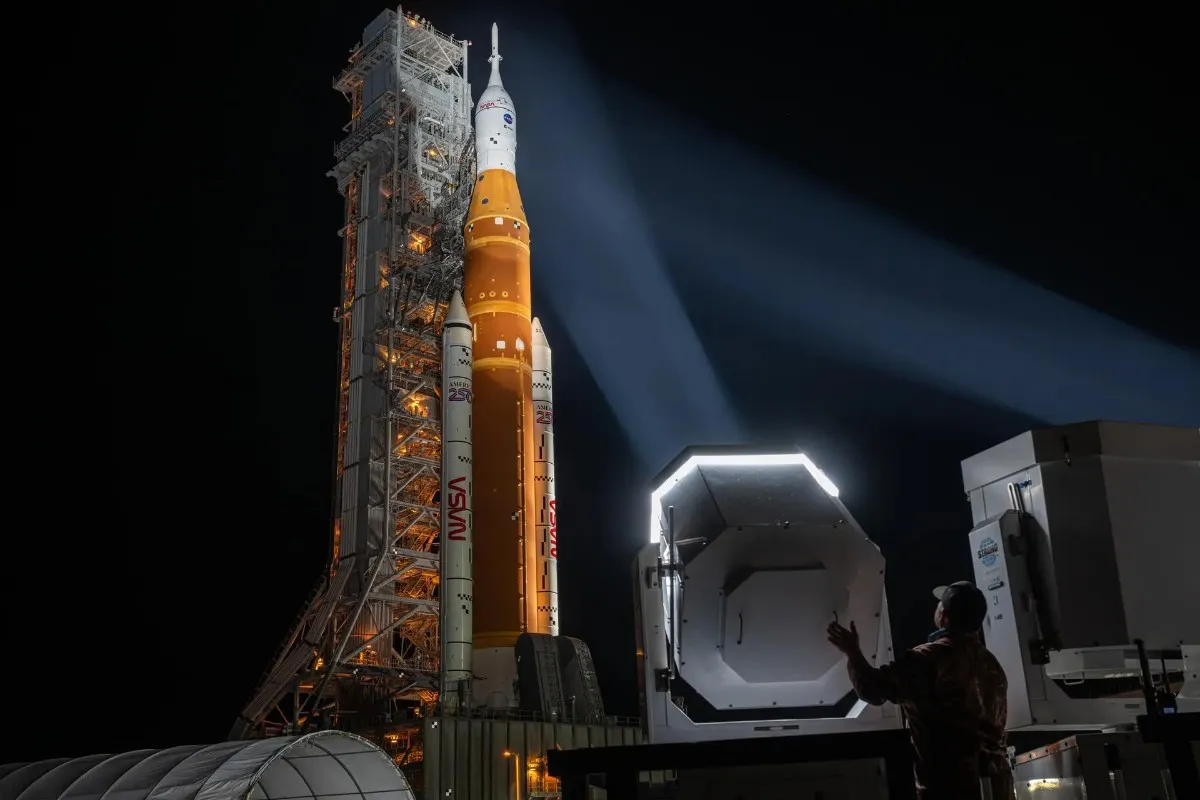
Four astronauts are going into quarantine at Kennedy Space Center's Launch Pad 39B for the April 1 crewed lunar liftoff. NASA's Artemis II SLS rocket and Orion capsule have arrived.
There was supposed to be a version of this moment that came years before. A version that was delayed by the pandemic, budget challenges, and a number of technical issues that made the first uncrewed Artemis flight feel more like a near-miss than a milestone. This morning, Launch Pad 39B at Kennedy Space Center still has the same thing on it, no matter what happened in the past. The Orion crew capsule was loaded on top of NASA's Space Launch System rocket, which rolled out of the Vehicle Assembly Building on March 27. It is now secured in place for a planned launch on April 1. An American rocket is getting ready to transport people beyond Earth's orbit for the first time since December 1972.There are four people on the Artemis II crew, and each one of them is important in a way that would have seemed impossible in the Apollo era. The mission is led by Commander Reid Wiseman, a veteran U.S. Navy test pilot and previous commander of the International Space Station. Pilot Victor Glover is the first Black person to go to the moon as an astronaut. Christina Koch, a mission specialist, is the first woman to travel on a path that will take her crew around the Moon. And Jeremy Hansen, a Mission Specialist from the Canadian Space Agency, is the first non-American to be appointed to a crewed lunar flight. On March 23, all four went into pre-launch quarantine, following the same medical isolation rules NASA has used for years to keep crews from getting sick at the last minute. They won't be able to have unrestricted communication with the public again until after splashdown, which is projected to happen about ten days after launch.The mission itself is not a landing. Artemis III, which is set to launch no early than 2027, holds that honor. Artemis II is a cislunar shakeout, which is a high-stakes test mission to make sure that the full crewed system performs exactly as the uncrewed version said it would. The crew will ride the SLS out of Earth's atmosphere, do a series of performance checks in low Earth orbit, and then start the Orion's service module engine to send it on a path to the Moon. At its deepest point, the spacecraft will go about 4,600 miles over the far side of the Moon on a free-return arc before swinging back toward Earth and landing in the Pacific Ocean.The free-return trajectory isn't just an accident of mission planning; it's the safety net. If anything on Orion stops working just on the way out, the physics of the arc will return the crew home without a second burn. That margin was based on the same basic logic that rescued Apollo 13, and it shows how seriously NASA's engineers have taken a mission where the stakes are not just reputational but also human. Based on data from Artemis I, the uncrewed test flight in December 2022 that landed in almost perfect condition after 25 days in deep space, the Orion capsule's life support systems, thermal protection shield, abort capability, and long-duration power management have all been improved.What Artemis I couldn't test the variable that it left out on purpose: humans. People create carbon dioxide, humidity, heat, vibration, and random interactions with spaceship systems that simulations and mannequins can't perfectly copy. Wiseman and his team will spend a lot of time on the trip going through an evaluation checklist that has never been used in a real operational setting. They will test the manual piloting interface that Orion's crew needs to know how to utilize in case the automatic systems break down. They will check the emergency pressure suit techniques at distances where a rescue is not possible. They will check that the environmental control system keeps the cabin conditions within acceptable limits for the whole mission. Each of them is a known unknown. Test engineers are sure they will pass, but they can't be sure until a person is actually sitting in the seat.The Space Launch System is a contraption with proportions that are hard to understand without thinking about them. It is 322 feet tall when fully stacked, which is 18 feet taller than the Saturn V rocket that took the Apollo missions to the Moon and 40 feet taller than the Statue of Liberty, including its base. The core stage has four RS-25 engines that burn liquid hydrogen and liquid oxygen. These engines are the same ones that powered the Space Shuttle orbiter for thirty years. At ignition, they produce 1.6 million pounds of thrust. Then, the twin solid rocket boosters add another 7.2 million pounds to the total. The whole rocket uses up its fuel in around eight minutes. The engines that make such output are then thrown away in the water. Orion is the only one who comes home.People in the aerospace industry and members of Congress who have seen the SLS budget expand across several administrations have been critical of that strategy because of its high cost. SpaceX's Starship, created by Elon Musk, is meant to be totally reusable. It hasn't yet flown with a crew to deep space, but its per-launch costs are expected to be much lower than SLS's over any long mission cadence. NASA is aware of this comparison. The agency signed a contract with SpaceX to use a modified Starship as the Artemis III lunar lander. This means that the mission that comes after Artemis II will depend on a vehicle built by a competitor whose design implicitly suggests that NASA's own rocket is not the right tool for the job. The outcome of one mission probably won't address that tension, but a successful launch on April 1 would at least calm the most pressing concerns about whether the SLS program can deliver on its promises.For the international partners watching from mission control and from space agencies on three continents, the moment is more important historically than financially. The European Space Agency created the service module that is attached to the back of Orion. This is the part that will provide propulsion, power, thermal regulation, and water storage for the whole mission. ESA's participation is both a practical benefit and a symbol of the multilateral nature that NASA has put into the Artemis program from the start. More than 40 countries have now signed the Artemis Accords, which established rules for responsible lunar exploration. The US came up with these rules in part to oppose the framework that China and Russia have suggested for their own joint lunar mission. On April 1, something happens over Launch Pad 39B that isn't just a scientific occurrence. It also says who wants to make the rules for how people will return to the Moon.The four astronauts who are in quarantine are, in the most direct sense, carrying all of that. They are carrying the engineering goals of a program that has been in the works since the last Space Shuttle flight in 2011. They are carrying the names and some of the legacies of the twelve men who walked on the moon between 1969 and 1972. They are carrying the hopes of a generation of aerospace professionals who were hired just to create the hardware that is presently on the pad. If the countdown goes well and the weather at Kennedy is good, they will launch all of it on April 1 and send it on a path that no human crew has taken in more than fifty years. The pad is set up. The rocket is all set. The crew is as ready as they can be after training and waiting.