Trump Orders Accelerated Quantum Computing Push With 2028 Target
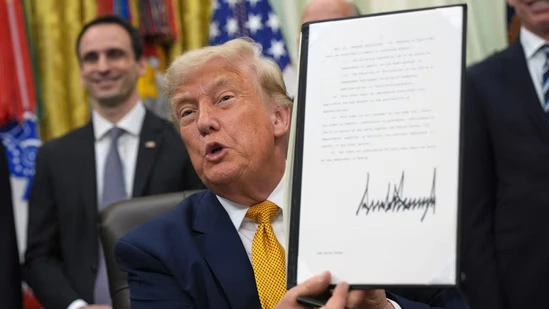
President Donald Trump has signed
Two executive orders aimed at speeding the development of quantum computing in the United States while preparing government systems for the cybersecurity challenges the technology could eventually create.
The initiative sets a national goal of developing a powerful quantum computer for scientific research by 2028 and expands federal efforts to secure America’s position in a field increasingly viewed as critical to economic competitiveness and national security.
Under the orders, federal agencies will work more closely with private companies, national laboratories and academic institutions to advance quantum computing and related technologies, building on approximately $2 billion in previous federal investment.
White House Sets 2028 Quantum Computing Goal
At the center of the plan is a directive calling for the creation of a powerful quantum computer capable of supporting advanced scientific research by 2028. The Department of Energy will take a leading role in defining technical requirements and coordinating development efforts across government agencies, research institutions and industry partners.
Scientists have long viewed quantum computing as one of the most promising frontiers in technology. Unlike conventional computers, future quantum systems could tackle exceptionally complex calculations that remain out of reach today. Researchers believe those capabilities could accelerate advances in materials science, drug discovery, climate modeling and artificial intelligence. The administration's timeline is notably ambitious. Many technology companies have projected the arrival of large-scale fault-tolerant quantum systems closer to the end of the decade. The White House hopes that coordinated public-private partnerships and expanded research efforts can shorten that timetable.
Officials said meeting the 2028 target would serve as a clear demonstration of American leadership in a technology expected to shape both economic growth and national security for decades.
Preparing for the Post-Quantum Security Era
A separate executive order focuses on a challenge that has become increasingly prominent among cybersecurity experts: the possibility that future quantum computers could break many of today’s encryption systems. Federal agencies have been directed to accelerate the transition to post-quantum cryptography, which is designed to remain secure even against powerful quantum-based attacks.
The administration also moved forward key deadlines for safeguarding government networks, setting targets for stronger cryptographic protections by 2030 and 2031. Officials warned that sufficiently advanced quantum computers could eventually compromise encryption standards that currently protect communications networks, financial systems and sensitive government information. Although such systems have not yet been developed, cybersecurity specialists have repeatedly urged governments and businesses to begin preparing well in advance.
The executive orders also call for deeper cooperation with allied nations on supply-chain security, intellectual-property protection and the development of international standards for quantum technologies.
Pentagon Expands Focus on Quantum Applications
The administration's strategy extends beyond computing power and cybersecurity. Federal agencies have been instructed to accelerate work on quantum-enabled sensors and related technologies, with the Pentagon tasked with pursuing operational quantum sensors by 2028. Officials believe such systems could improve navigation in environments where GPS signals are unavailable and could help detect underground facilities from space. Those capabilities are viewed as potentially valuable for future military and defense operations.
Over the next five years, NASA, the Commerce Department and other federal agencies are expected to develop plans for quantum networks and advanced sensing systems. Officials say the technology could eventually benefit transportation, communications, scientific research and national defense.
Industry leaders from major technology companies attended the signing ceremony, reflecting the growing partnership between government agencies and private-sector researchers. Administration officials argued that combining federal investment with private innovation will be essential as competition in the global quantum sector intensifies. With governments and technology companies around the world racing to unlock the promise of quantum computing, the executive orders mark one of the most significant U.S. policy efforts so far to accelerate development, strengthen security and secure a leading role in a technology widely expected to reshape the future.