Puerto Rico’s Home-Battery ‘Virtual Power Plant’ Is Helping Keep the Lights On as Outages Persist
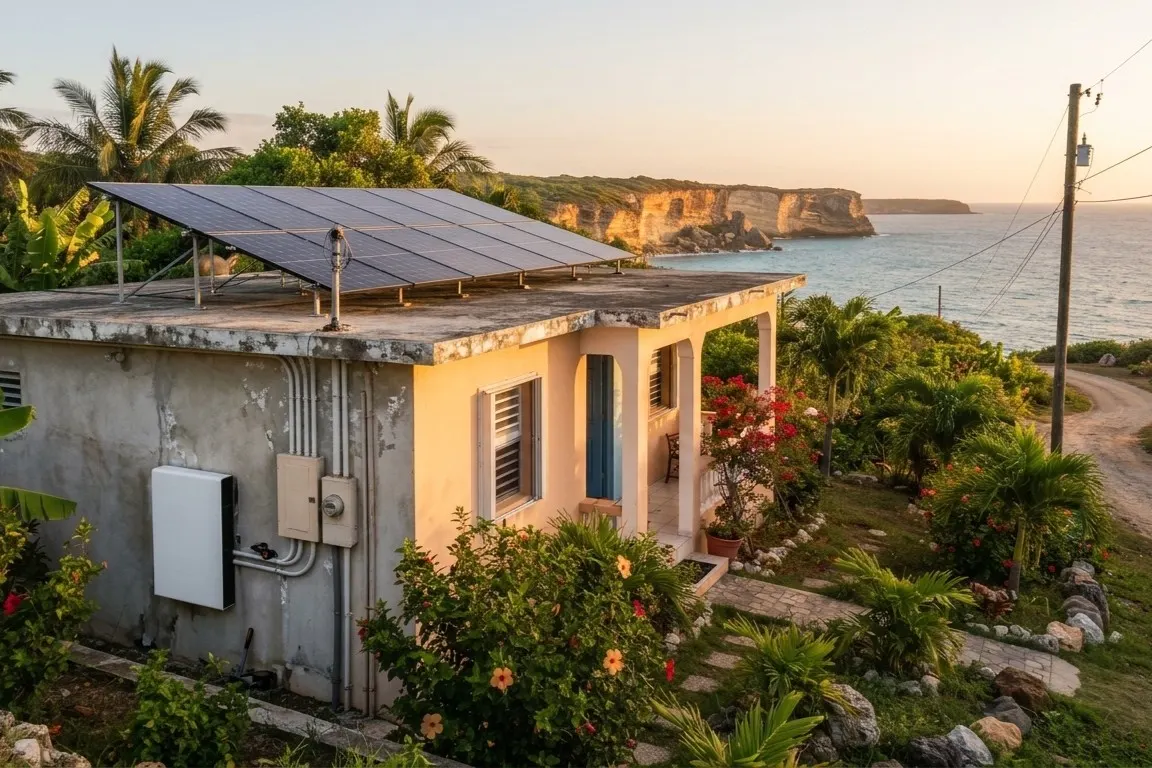
Puerto Rico is using the home batteries of nearly 115,000 households as a backup power source for its strained electric grid, an arrangement known as a “virtual power plant,” according to an Associated Press report published on November 17, 2026.
The Associated Press described the program as the first of its kind in Latin America and the Caribbean and the second largest in the United States by capacity. Luma Energy, the island’s grid operator, says the network has prevented or reduced outages more than 60 times since June 1.
One participant is Hector Ríos, a 75-year-old resident of Cabo Rojo who has rooftop solar panels and a Tesla Powerwall battery. The utility drew power from his battery on nearly 20 days in October, and he is paid for the energy.
The program has become one of the clearest signs of how Puerto Rico is working around a generation system that cannot always meet demand, nine years after Hurricane Maria exposed how fragile the grid was.
How the Battery-Sharing Program Works
Luma launched a small pilot in late 2023, and the Associated Press reports that more than half of Puerto Rico’s solar customers now take part. The program is formally called Customer Battery Energy Sharing, or CBES, according to the energy news site Electrek.
When Luma expects a shortfall between available generation and demand, enrolled customers receive a digital notice of an upcoming “battery sharing event.” They can opt out through an app or choose how much of their battery to share. Enrollees typically offer about 30 percent.
Each event usually lasts about four hours and supports the equivalent of roughly 80,000 residential customers, the Associated Press reported. Companies known as aggregators, including Sunrun, coordinate the batteries automatically, Electrek reported.
Luma pays solar providers three times the residential electricity price for the energy it takes, and what customers receive varies by provider. Ríos and his wife were paid $162 last year, which they spent on a store gift card.
Why Puerto Rico Needs a Backup for Its Grid
The island’s power authority, PREPA, filed for bankruptcy nine years ago, and Hurricane Maria in 2017 left some communities without electricity for nearly a year. Residents still face unpredictable blackouts and some of the highest electricity rates in the country.
Electrek, citing U.S. Energy Information Administration data, reported that residential power averaged 26.36 cents per kilowatt-hour in August, compared with 18.16 cents nationally. In 2025, Puerto Rico customers averaged 36 hours without power, excluding major events, up 19 percent from 2024. Customers on the U.S. mainland average about two hours on the same measure.
Few large power plants have been built since Maria, and most federal recovery money has not yet reached the territory, the Associated Press reported. Puerto Rico will spend more than $1.7 billion this year importing fuel to generate most of its electricity.
That fuel dependence was visible again this month. The San Juan Daily Star reported on November 16 that the federal fiscal oversight board approved, with observations, a diesel supply contract of up to $620 million for Genera PR, while renewing its concerns about competition in fuel procurement.
Washington has also stepped in. T&D World reported that the U.S. Department of Energy renewed two emergency orders for Puerto Rico’s grid on November 8, running through February 5, 2027, covering the dispatch of generating units and vegetation management near power lines.
Rooftop solar has filled part of the gap. Puerto Rico now has more than 207,000 rooftop systems, roughly 20 times the number before Maria, for a population of fewer than 3.2 million people. Nearly every installation includes a battery.
What the Numbers Show
Sunrun, which says it is the largest aggregator in the program, told Electrek that more than 60,000 customers and nearly 70,000 batteries are enrolled in its Puerto Rico network. It frequently delivers 45 megawatts for four hours at a time, according to Electrek.
Electrek reported that Sunrun has dispatched the network more than 60 times since April. The grid tapped the batteries on 18 straight days in October, beginning on October 13 during unusually hot weather.
Across all aggregators, Luma reported in July that more than 90,000 participating customers provided an average of 75 megawatts during generation shortfalls.
The program has limits. An April regulatory filing, cited by Electrek, said aggregators could not prevent every rolling blackout in 2025 because some supply gaps exceeded the roughly 50 megawatts of four-hour capacity available then. Aggregators say they plan to enroll more batteries to cover larger shortfalls.
Supporters, Critics and Open Questions
Javier Rúa Jovet, chief policy officer at the Solar and Energy Storage Association of Puerto Rico, told the Associated Press, “There’s nothing virtual about it.” He added, “It’s real, and it’s better than a power plant.” He argues the cost of sharing a battery is small compared with the losses from outages, and he sees daily use as a natural next step toward Puerto Rico’s legal goal of 100 percent renewable energy by 2050. He cautioned that a virtual power plant alone cannot solve the crisis.
Jigar Shah, who directed the Department of Energy’s Loan Programs Office under President Joe Biden, called the program an “emergency escape valve” and argued that batteries should be a regular grid asset. He noted that California and Texas already use solar and batteries that way.
Luma’s chief regulatory officer, Alejandro Figueroa, said the program “could potentially play a larger role in Puerto Rico’s energy future,” but that daily use would need a different design and compensation structure. Luma also says heavy reliance on battery sharing has partly contributed to recent rate increases.
Some participants are less enthusiastic. A 2026 survey by the nonprofit Solar United Neighbors found that some customers criticized the compensation, while others hesitated to enroll because they did not understand the program or feared losing backup power. Ríos calls the payment system “a little vague,” and he now skips sharing events when bad weather is forecast after a storm knocked out his power once right after he shared his battery.
The Associated Press also noted that the Trump administration promotes expanding fossil fuels and has redirected funds away from solar projects in Puerto Rico.
What Comes Next
Experts quoted by the Associated Press describe the virtual power plant as an emergency measure rather than a long-term fix. They say solving Puerto Rico’s outage problem will take billions of dollars in unspent federal recovery funds, upgrades to transmission and distribution lines, and new large-scale generation and storage.
The model is also spreading. Nathalie Jordi of Together New Orleans described a planned $23 million program in that city to network more than 1,000 batteries on homes and businesses.
For now, Puerto Rico’s battery network is doing what regulators and the utility need most: covering short, predictable shortfalls so fewer neighborhoods go dark. Whether it becomes a daily grid resource will depend on how it is paid for and who bears the cost.
Related Coverage
- → Associated Press via WLRN: As outages persist, Puerto Rico finds a way to help keep the lights on with ‘virtual power plant’
- → Associated Press via KSTP: As outages persist, Puerto Rico finds a way to help keep the lights on with ‘virtual power plant’
- → Electrek: Puerto Rico tapped Sunrun’s home batteries for 18 straight days
- → San Juan Daily Star: Fiscal board approves $620 million diesel supply contract for Genera, raises competition concerns
- → T&D World: DOE renews emergency orders to support Puerto Rico’s electric grid reliability