U.S. Supreme Court Expands Presidential Power While Blocking Key Trump Policies in Landmark 2026 Rulings
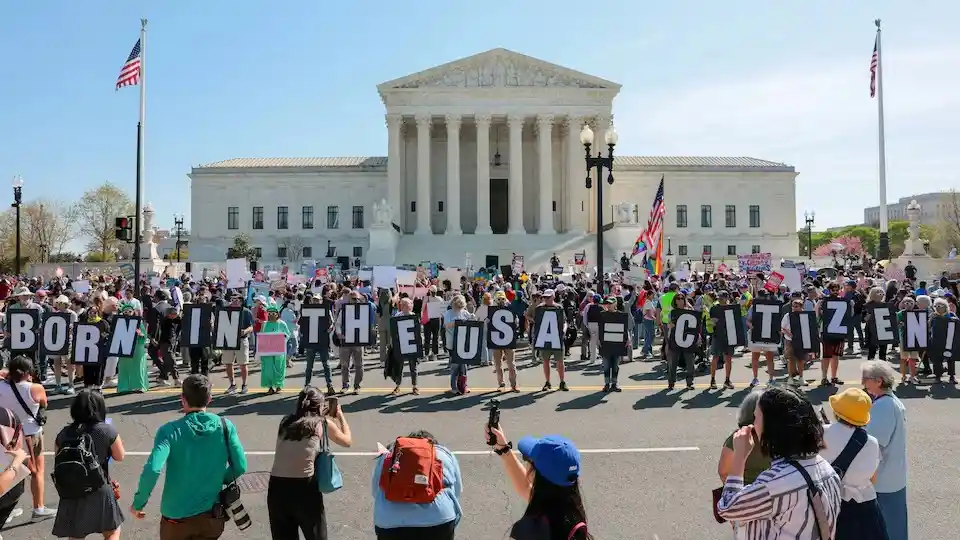
Handing President Donald Trump a stinging defeat, the U.S. Supreme Court on Tuesday rejected his audacious attempt to restrict birthright citizenship in the United States — a right long woven into the fabric of American society — scuttling one of his top priorities in his crackdown on immigration.
The justices in a 6-3 ruling authored by conservative Chief Justice John Roberts decided that Trump's directive violated language in the U.S. Constitution's 14th Amendment that confers citizenship to those born in the United States who are 'subject to the jurisdiction thereof'. They upheld a lower court's decision that blocked Trump's executive order that had directed U.S. agencies not to recognize the citizenship of children born in the United States if neither parent is an American citizen or legal permanent resident.
Roberts was joined by fellow conservative Justices Brett Kavanaugh and Amy Coney Barrett, as well as the court's three liberal justices, in rejecting Trump's order. The ruling marked the third time this year that the court invalidated a major Trump initiative, following its February decision to strike down his sweeping global tariffs and a rejection on Monday of his bid to immediately fire Federal Reserve Governor Lisa Cook.
Roberts: 'We Keep That Promise'
The 14th Amendment was ratified in 1868 in the aftermath of the Civil War that ended slavery, and overturned a notorious 1857 Supreme Court decision that had declared that people of African descent could never be U.S. citizens. 'Citizenship, then and now, was the right to have rights — to freely participate in our political community,' Roberts wrote, adding that the authors of the 14th Amendment extended that promise to every free-born person in the land. 'We keep that promise today,' Roberts wrote.
Kavanaugh, while agreeing with the ruling's outcome, disagreed with its rationale. He said in a concurring opinion that the order contravenes a separate federal law codifying birthright citizenship rights but not the 14th Amendment itself.
Trump Calls Ruling 'Too Bad for Our Country'
Following Tuesday's ruling, Trump wrote on his Truth Social platform that the ruling was 'too bad for our Country, but we can easily make it up in Congress through Legislation, with the support of the President, that has now been determined during this process.' He called for Congress to start working on ending birthright citizenship, adding that no lengthy constitutional amendment is necessary. 'They will have my Complete and Total Support!' Trump wrote.
Stephen Miller, White House deputy chief of staff, called the ruling 'one of the most destructive and outrageous decisions in the long history of the Supreme Court,' arguing that 'American citizenship is not the birthright of the world.'
Dissents Focus on Original Meaning
Conservative Justices Clarence Thomas, Samuel Alito and Neil Gorsuch dissented. Thomas, in a dissent joined by Gorsuch, wrote that many potential applications of Trump's order are consistent with the original public meaning of the Constitution. The ruling 'takes the extraordinary step of holding facially unconstitutional the president's order excluding from citizenship the children of foreign temporary visitors and illegal aliens,' Thomas wrote.
In a separate dissent, Alito decried the ruling, saying it grants citizenship to the children of 'birth tourists.' He said careful analysis of the text of the 14th Amendment shows it does not 'degrade the concept of United States citizenship in this way.'
Impact on Immigrant Families
Ahead of the ruling, some experts had estimated that Trump's directive could affect the legal status of as many as 250,000 babies born each year and could require the families of millions more to prove the citizenship status of their newborns. 'The court's decision reaffirms a fundamental American promise — if you are born here, you are a citizen,' said ACLU National Legal Director Cecillia Wang, who argued the case on behalf of the challengers at the Supreme Court. 'A president cannot change the Constitution by executive fiat,' Wang added.
The legal challenge involved a class-action lawsuit filed in New Hampshire by parents and children whose citizenship was threatened by the directive. The challengers argued that the Supreme Court already had settled the question of birthright citizenship in an 1898 case called United States v. Wong Kim Ark, which recognized that the 14th Amendment grants citizenship by birth on U.S. soil, including to the children of foreign nationals.
The Wong Kim Ark Precedent and the Citizenship Clause
Roberts cited the Wong Kim Ark case heavily, noting that in the 128 years since that decision, the court has repeatedly understood its rule to guarantee citizenship to all children born in the United States and subject to its power. He said there was 'scant evidence' to support the Trump administration's 'dramatically revisionist view' of how to interpret the citizenship language of the 14th Amendment to limit birthright citizenship.
The Citizenship Clause states: 'All persons born or naturalized in the United States, and subject to the jurisdiction thereof, are citizens of the United States and of the state wherein they reside.' The administration had argued that the phrase 'subject to the jurisdiction thereof' means that being born in the United States is not enough for citizenship, and excludes the babies of immigrants who are in the country illegally or whose presence is lawful but temporary. The court firmly rejected that interpretation.