NASA Data Confirms 27 New 'Tatooine' Planets on Star Wars Day
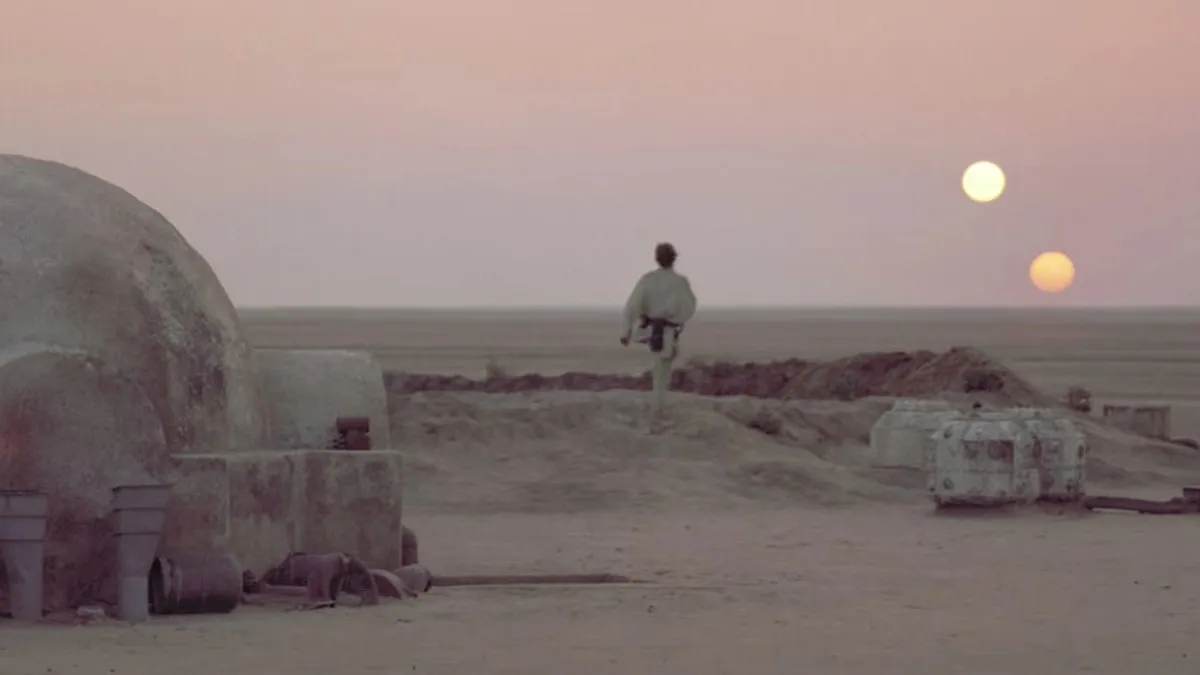
Astronomers have identified 27 potential new planets orbiting two suns using NASA's TESS telescope, proving 'double sunsets' like the fictional Tatooine are more common than we thought.
The announcement landed on a day that the internet had already claimed for its own. May 4, which has become an unofficial celebration of the Star Wars franchise, is the kind of date that public affairs teams at scientific institutions mark on their calendars months in advance. This time, NASA's Jet Propulsion Laboratory gave them something real to work with. A new analysis of data collected by the Transiting Exoplanet Survey Satellite, better known as TESS, has identified 27 candidate planets that orbit not one star but two, making them circumbinary planets — the class of world that the Star Wars universe made famous when Luke Skywalker watched twin suns dip below the horizon on Tatooine.The research, led by a team from the University of California San Diego and published Monday in The Astronomical Journal, is the most comprehensive catalog of circumbinary planet candidates to emerge from TESS data since the space telescope launched in 2018. Of the 27 candidates, the team flagged eight as high-priority targets for follow-up observation with ground-based telescopes and, eventually, the James Webb Space Telescope. Three of the candidates fall within their system's habitable zone — the orbital band where liquid water could theoretically persist on a rocky surface.The fact that we're finding this many in a relatively small slice of the sky suggests these systems are not rare outliers, said Dr. Sarah Millholland, one of the paper's co-authors.They're a normal outcome of planetary formation around binary stars.Finding a planet around a single star is difficult. Finding one around two stars that are themselves orbiting each other is considerably harder. The gravitational environment of a binary system creates what astronomers call a chaotic zone close to the stellar pair, where the competing pulls of two stars make stable orbits nearly impossible. For a planet to survive, it has to form far enough out that the combined gravitational field behaves, at a distance, more like a single massive object. That constraint means most circumbinary planets discovered to date have turned up in wide, cold orbits. The question the TESS survey is beginning to answer is whether tighter, potentially habitable orbits are also possible — and whether they are survivable over geological timescales.TESS detects planets using the transit method. When a planet crosses in front of its host star from TESS's line of sight, it blocks a small fraction of the star's light, producing a measurable dip in the brightness curve. For circumbinary planets, that technique becomes dramatically more complex. Because the two stars are moving relative to each other and relative to the planet, transits do not repeat on a fixed schedule the way they do in single-star systems. Each transit occurs at a slightly different time depending on where both stars are in their mutual orbit. The TESS team developed a dedicated algorithm to search for these irregular transit signatures, and the 27 new candidates are the direct product of that work.Not all 27 will survive the confirmation process. In previous TESS circumbinary searches, a meaningful fraction of candidates turned out to be false positives caused by eclipsing binary stars whose brightness dips mimic a planetary transit. The eight high-priority candidates were selected in part because their light curves showed multiple transits at different depths and timings that are very difficult to explain without a third body in the system. Two of the eight have already been scheduled for observation with the Gemini Observatory in Hawaii.The 27 candidates bring TESS's total tally of confirmed and candidate circumbinary planets to more than 50 since the mission began. That number stands in sharp contrast to the Kepler space telescope's legacy catalog, which identified only a dozen confirmed circumbinary planets across a full decade of operation. The improvement is partly a product of TESS's sky coverage — Kepler stared at a single patch of sky, while TESS has surveyed more than 85 percent of the entire celestial sphere — and partly a product of the improved detection algorithms trained on Kepler data.The habitable zone candidates are drawing the most immediate attention from the research community. Two of the three sit in systems with K-type stars, which are somewhat cooler and smaller than the Sun and are considered favorable hosts for habitable planets because they are longer-lived and emit less ultraviolet radiation. The third is in a system with two M-dwarf stars, the most common stellar type in the Milky Way. M-dwarf habitable zones sit much closer to their stars than Earth sits from the Sun, which raises questions about tidal locking and stellar flare activity. Whether any of the three could sustain liquid water on a surface depends on factors — atmospheric composition, planetary mass, orbital eccentricity — that current data cannot yet resolve. What current data can confirm is the timing. NASA's communications office did not release the paper on May 4 by accident. The agency has long understood that science reaches further when it arrives with cultural context already attached, and the Tatooine comparison is one of the most effective frames in the repertoire. When the Kepler mission confirmed the first circumbinary planet, Kepler-16b, in 2011, the discovery team released a visualization of what the double sunset would look like from its surface. That image circulated far beyond the usual science news audience. The TESS team has prepared similar visualizations for three of the new candidates.The broader implication of the survey is one that planetary scientists have been building toward for years. The early assumption in the field was that binary stars — which account for roughly half of all Sun-like stars in the galaxy — were fundamentally hostile to planet formation. The gravitational complexity, the reasoning went, would either prevent planets from coalescing in the first place or would quickly destabilize any that managed to form. What surveys like this one are showing is that assumption was wrong. Planets form around binary stars with something approaching the same frequency as they form around single stars. The galaxy's total planet population may be nearly twice as large as models built on single-star assumptions have ever suggested.For the researchers who built the detection algorithm and spent months sifting through TESS light curves, the Star Wars timing is a footnote. The science does not need the franchise to be significant. But on a day when millions of people are already thinking about a fictional desert world with two suns, twenty-seven new reasons to believe such worlds are real is not the worst possible news to deliver.