Scientists Identify the Birdsong Qualities Humans Find Most Pleasant
Some birds are soothing and melodic, while others may be harsh or unpleasant to hear. Why? A new study by researchers at the University of Tübingen in Germany offers some clues by looking at the acoustic properties that shape how humans perceive bird vocalizations.
Researchers had 84 people listen to recordings of calls from 123 different species of European birds, and rate how nice they thought each call was. They then compared these ratings with quantifiable properties of the vocalizations such as frequency, amplitude, bandwidth and complexity.
Results suggest that there is not a single acoustic feature responsible for the attractiveness of a birdsong. Rather, it appears that a number of factors are involved. Participants were more likely to judge positively sounds with specific frequency characteristics, lower amplitude, narrower bandwidth, and more vocal complexity.
The researchers also found that how much people knew about birds did not matter much in deciding which sounds they liked best. The pleasantness ratings were not significantly related to birding specialization, suggesting that the response may be related to aspects of human sound perception that are not dependent on specialist knowledge.
This study is a component of a larger research project investigating the effects of natural sounds on human experiences. Bird song is an important part of the natural soundscapes, and understanding why we perceive certain sounds as positive may eventually help researchers and urban planners to think differently about parks, gardens and other recreational settings.
The researchers stress that the results show correlations between acoustic features and perceived pleasantness, not definitive answers about why the human brain favors some birdsongs.
Common Blackbird Scores Highest in Pleasantness
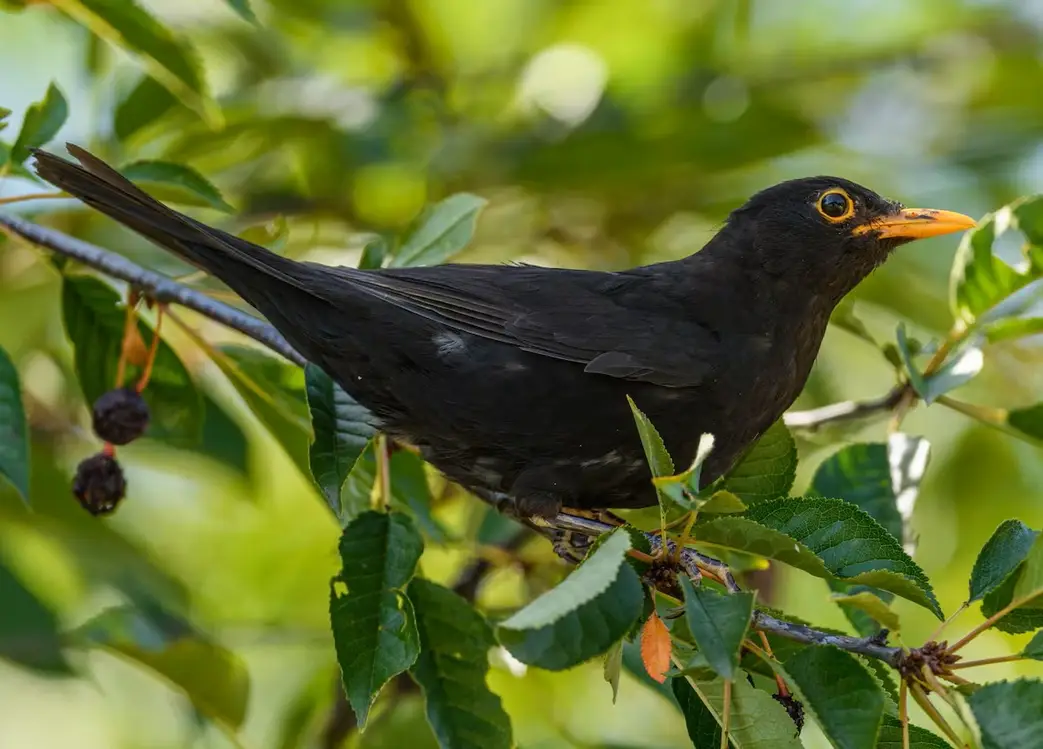
The most pleasant species on average of the 123 species in the experiment was the common or Eurasian blackbird (Turdus merula). Its score was 4.52 out of 5, the highest of any species tested.
The common blackbird is widely distributed in Europe, and is a familiar bird of gardens, parks and woodland habitats. Its deep, flowing, flute-like song is often a draw for listeners.
The European goldfinch also did well, scoring 4.26, while the European robin and the blue tit got 4.04 and 3.92 respectively. At the lower end of the scale the barn owl received the lowest average score of 1.32 out of five.
This difference indicates that species may respond quite differently to bird vocalizations. Specifically, the scientists wanted to know if those differences were associated with objective properties of the sounds, and not just familiarity with certain birds.
Interestingly, the more complex vocalizations were more likely to be rated as more pleasant, the study found. This contradicts the intuitive assumption that simple, repetitive sounds would inherently be easier or more pleasant to listen to.
But the researchers warn against interpreting the high score of the common blackbird as its having the "best" song of all. This study was conducted with German adult listeners and perceptions may be affected by individual and cultural experience in other populations.
Sound Preferences as a Function of Frequency Amplitude & Complexity
The study found some acoustic features to be related to higher pleasantness ratings. Participants generally preferred sounds with higher low and peak frequencies, lower amplitude, and narrower bandwidths. Vocal complexity was also associated with higher pleasantness ratings.
The results indicate that humans perceive birdsong in a multidimensional way. Not all pleasant sounds are high-pitched, quiet or complex. Instead, listener responses appear to be based on combinations of acoustic properties.
The researchers also found that people who said they valued birds more rated bird sounds as more pleasant. Specialist birding experience, however, was not significantly associated with pleasantness. This implies that a general liking for birds can shape perception even in the absence of specific knowledge of bird species or calls.
But scientists who study how we hear say personal experience can still play an important role. Familiar birds may remind people of a particular place, season or environment, and this can affect how people react to them.
So the study does not give a one-size-fits-all recipe for a beautiful birdsong. Different species can make very different sounds and still get high scores.
The lead researchers said the next phase of work should look at why the acoustic characteristics identified are appealing and whether similar preferences are found among people from different cultures and environments.
That difference is important, because current research provides correlations between quantifiable sound features and human ratings, but not yet the precise neurological or evolutionary mechanisms behind those preferences.
Birdsong as a Model for Natural Soundscapes in Cities
The findings may have implications beyond understanding why people enjoy listening to birds. The researchers say the findings could one day help guide the design and management of urban green spaces and recreational settings.
Environmental noise in modern cities is generally considered a problem to be reduced. Research on birdsong has also shown that the composition of a soundscape can be important. Natural sounds can influence people's perception of place, so planners might want to consider not just how noisy an area is, but what kinds of sounds are there.
Prior research has linked exposure to natural environments and perception of birdsong with psychological restoration and well-being. For example, another study published in 2026 in the Journal of Urban Ecology found that nature walks that included attention to birdsong were associated with better mental well-being and lower physiological measures of stress in its participants.
But researchers caution against adding recorded birdsong to our cities. Authors referred to prior research which found that artificially adding more birdsong did not increase the well-being benefits compared to naturally occurring birdsong.
There are also conservation issues. If they focus only on species that are attractive to them or that have a sweet-sounding name, environmental planners may miss less conventionally attractive birds and their potentially ecologically important roles.
So the new research is a launch pad, not a destination. This suggests a potential impact of the acoustic properties of bird communities on human experience of natural spaces, but also raises questions relating to biology, culture, familiarity and individual preference.
Understanding those interactions could help scientists get a better sense of the connections between biodiversity, soundscapes and human experience.