NASA Launches Roman Space Telescope to Explore Dark Energy, Exoplanets and the Hidden Universe
NASA has successfully launched its latest flagship observatory, the Nancy Grace Roman Space Telescope, on an ambitious mission to answer some of the most nagging remaining questions in astronomy, including the mysteries of dark energy, dark matter and planets beyond our solar system.
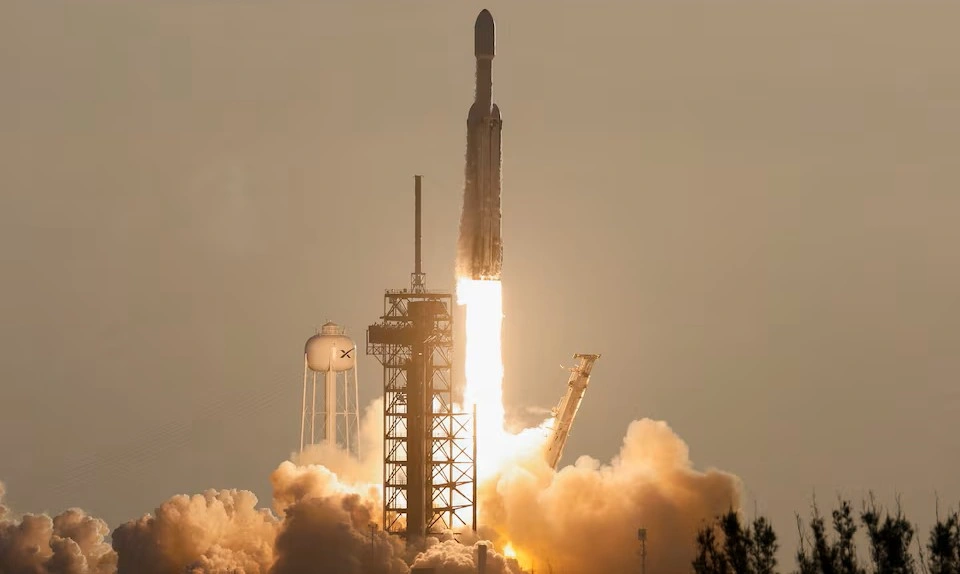
The telescope was launched from the Kennedy Space Center in Florida on a SpaceX Falcon Heavy rocket, a key milestone for NASA’s next generation of space science.
The Roman Space Telescope will change how scientists see the universe. With a wide field of view and state-of-the-art infrared observing technology, investigators can survey large regions of space far more rapidly than previous observatories.
Roman Telescope Launches Deep into Space on Falcon Heavy Rocket
The telescope was launched on Aug. 30, 2026, from Cape Canaveral, Florida, on SpaceX’s Falcon Heavy rocket. When it was launched, Roman began its journey to a place called Lagrange Point 2 (L2), a few million miles from Earth. From now on it will orbit the Sun in the same position relative to the Earth.
The mission is planned to last at least 5 years, with extensions possible depending on the health of the spacecraft and the resources available. The successful launch comes after years of development and concerns about possible funding problems that could have jeopardized the mission’s future.
Roman Telescope to Unlock the Universe’s Biggest Mysteries
The Roman Space Telescope’s primary science goal is to broaden our understanding of the universe.
Scientists hope the observatory can give new clues about dark energy, a mysterious force thought to be causing the universe to expand faster. The Roman will also be used by researchers to study dark matter — an invisible substance thought to make up a large fraction of the mass of the universe, but which cannot be observed directly with normal light. Roman will chart billions of stars and galaxies that will help scientists understand how cosmic structures form and evolve over billions of years.
The telescope will also seek out thousands of planets orbiting stars outside of our solar system, helping scientists learn more about how planets are born and the diversity of worlds in our galaxy.
Telescope Built to See Space Faster Than Hubble
Roman’s big advantage is that it will be able to see a much bigger chunk of space than previous telescopes. Roman is designed to take images of much larger portions of the sky in one observation, unlike the standard Hubble space telescope which takes very detailed images of small portions of the sky.
NASA says Roman will see more than 100 times farther than Hubble’s infrared instruments, meaning it can do large area surveys much more quickly. It will enable scientists to map the universe in detail and find distant objects that are much longer to find with previous technology. Roman will join other large observatories, including Hubble and the James Webb Space Telescope, that can each collect different types of observations.
Spy Satellite Technology for Space Observatory
The history of the Roman telescope is very interesting. Its primary mirror technology was transferred from a former U.S. intelligence satellite program to NASA for use in science.
The mission was later named for Nancy Grace Roman, NASA’s first chief astronomer, who helped shape the agency’s space astronomy program and established the foundation for the standard, or Hubble, Space Telescope.
It's one of the few instances where surveillance technology has been adapted as a scientific tool to help us learn more about the universe.
Roman Search for New Continents Beyond Earth
One of the key science goals of the mission is to find and study exoplanets, which are planets that orbit stars other than our Sun. Roman will employ new observation techniques, such as gravitational microlensing, to discover distant planets that are hard to detect by traditional methods.
The mission is expected to find thousands of new exoplanets and offer critical information about how planetary systems form and evolve over time. Roman wasn’t designed to be an alien hunter, but its discoveries could help identify worlds that might be good targets for future observations.
James Webb to Supplement Hubble Mission
NASA says, “Roman won’t replace Hubble or Webb, but will complement them.” James Webb Space Telescope will take detailed look at individual objects and distant galaxies, while Roman will do broad surveys of the cosmos.”
The three observatories will give scientists a wider view of everything from local planetary systems to the evolution of the universe itself. Roman’s ability to scan large swaths of space may also help pinpoint interesting targets for follow-up investigation by Webb and other telescopes.
Scientists Looking for Big Finds
Roman scientists hope it will one day help them answer fundamental questions about the past and future of the universe. The telescope will collect an enormous amount of data, making it one of the most detailed surveys of the universe ever assembled.
Astronomers hope the results will throw new light based on Creation and evolution of galaxies, Dark energy and the universe expansion, The distribution of dark matter, Quantity and characteristics of distant planets
We hope the results of this mission will influence astronomy for decades.
The New Space Age
The launch of NASA’s Nancy Grace Roman Space Telescope is a giant leap forward in expanding how we see the universe. Roman will provide scientists with a whole new way to study the cosmos, building decades of Hubble discoveries and the recent successes of James Webb.
Wide-area rapid imaging and infrared capabilities might reveal parts of space that have been hidden. As Roman sets off on its journey into deep space, scientists at NASA are turning to the telescope to help answer some of humanity’s oldest questions: How Did the Universe Come into Being? What happened? What Are the Worlds Outside of Earth?