Voyager 1 Becomes the First Spacecraft to Travel One Light-Day From Earth as NASA Probes a Data Glitch
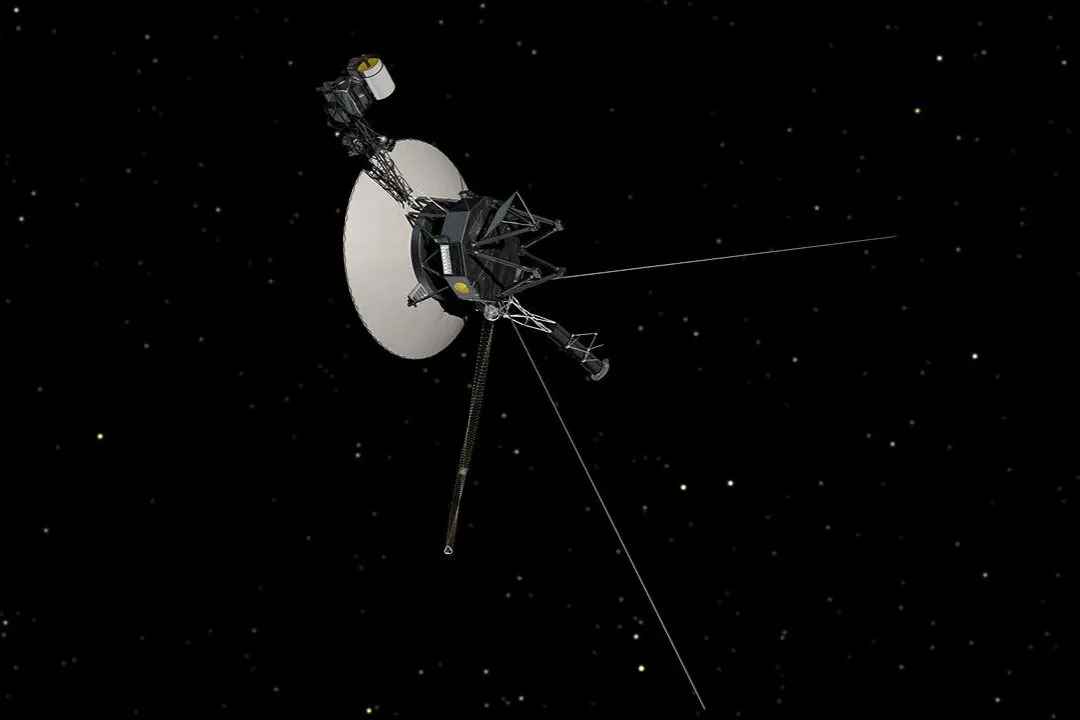
NASA’s Voyager 1 became the first spacecraft to reach a distance of one light-day from Earth on November 18, 2026, after more than 49 years of travel. NASA says the probe crossed the mark at 2:16 a.m. Pacific time (5:16 a.m. Eastern), when it was about 16.1 billion miles (25.9 billion kilometers) from home.
A light-day is the distance light covers in 24 hours, so a radio command sent to Voyager 1 now takes a full day to arrive, and the reply needs another day to come back. Mission engineers confirmed the milestone using the spacecraft’s carrier signal and trajectory calculations.
The achievement came with a complication. NASA said it has not received science or engineering data from Voyager 1 since November 14, and engineers are still analyzing what went wrong.
What One Light-Day Really Means
Voyager 1 launched on September 5, 1977, and now travels at roughly 38,000 miles per hour (61,155 kilometers per hour). NASA offers a way to picture the gap: sunlight takes about 1.3 seconds to reach the Moon and about four hours to reach Neptune, then roughly 20 more hours to arrive at Voyager 1.
Joe Westlake, director of NASA’s Heliophysics Division, called a light-day a “singular feat for a spacecraft.” Linda Spilker, the Voyager project scientist at NASA’s Jet Propulsion Laboratory (JPL), put it in simple terms: at the speed of light, Earth and Voyager 1 are now exactly 24 hours apart.
The probe is already far beyond the planets. According to Space.com, Voyager 1 became the first human-made object to leave the heliosphere, the bubble of solar particles surrounding the planets, on August 25, 2012. It has not technically left the solar system, because it is still within the Sun’s gravitational influence. Its twin, Voyager 2, took a slower path, entered interstellar space in 2018, and is not due to reach one light-day until 2035.
The Data Problem Overshadowing the Milestone
JPL spokesperson Raquel Villanueva said Voyager 1 stopped transmitting science and engineering data on Saturday, November 14. Voyager project manager Suzanne Dodd said the spacecraft is still sending a very strong carrier signal, but engineers have no “frame sync.” In practice, that means antennas on Earth can detect the signal but cannot read the data inside it.
Troubleshooting is slow at this distance. Because signals take 24 hours each way, Dodd said, each diagnostic step takes about two days, and data rates are very low. She described the problem as an age-related anomaly rather than a major long-term concern and said she expects the spacecraft to send data again before long. NASA says its engineers continue to analyze the issue.
Voyager 1 has been here before. In November 2023 it stopped returning readable data, and engineers tied that fault to the spacecraft’s flight data subsystem, one of its three onboard computers. According to JPL, the team restored usable engineering data in April 2024 after sending new code to a different location in the subsystem’s memory.
At the time of writing, NASA had not announced that normal data flow has returned.
Keeping a 49-Year-Old Probe Alive
Power is the other long-term challenge. NASA says both Voyager probes lose about 4 watts of power each year as the plutonium in their onboard generators decays. Engineers have turned off three devices on Voyager 1 and substituted three lower-power alternatives, a move NASA described as not without risk.
NASA says those measures should let both spacecraft keep their current suite of science instruments operating until at least their 50th launch anniversaries next summer. The agency’s Deep Space Network, a set of large antennas at three sites around the world, handles communication with the probes, and Dodd said the team listens to Voyager 1 every day and sends it commands weekly.
Celebrations on Earth and in Orbit
NASA marked the approach with “Shine Bright for Voyager’s Light-Day” on the evening of Tuesday, November 17, inviting people around the world to send a wave of golden light toward the spacecraft. According to NASA, thousands of people and places took part, using phones, flashlights, porch lights and even entire buildings. That day, Nicky Fox, NASA’s associate administrator for science, joined Ann Druyan to light the Empire State Building gold, Space.com reported.
On Thursday, November 19, the Voyager team gathered in JPL’s Von Karman Auditorium in Pasadena, California, for what Space.com described as the first such Voyager event since Voyager 2’s Neptune flyby in 1989. Spilker, who watched the 1977 launch, said she never imagined she would be there 49 years later.
NASA astronaut Jessica Watkins also sent a video greeting from the International Space Station, addressing the spacecraft as “Dear Voyager 1” on behalf of the Expedition 75 crew and finishing with a weightless backflip.
What Comes Next
The Voyagers remain active science missions. NASA says both probes continue to measure changes in the Sun’s magnetic field, and deputy project scientist Jamie Rankin said they are moving into a region where the Sun’s influence differs, which could help scientists understand space beyond it. Spilker has said the probes are changing scientists’ understanding of interstellar space, a region that had never been explored before.
Fox said the mission will never truly end, and Dodd noted that each spacecraft sets a record for longevity or distance every day. When Voyager 1 can no longer communicate with Earth, Dodd said, it will become humanity’s silent ambassador to the stars. Both probes carry a gold-plated copper phonograph record with images and sounds from Earth, meant as a message for any advanced civilization that might find it.
For now, the priority is simpler: getting readable data flowing again. Engineers face a two-day wait for every answer, and the 50th launch anniversaries arrive next summer.
Related Coverage
- → NASA: NASA’s Voyager 1 Makes History Reaching One Light-Day From Earth
- → Space.com: 1 light-day from Earth! NASA’s Voyager 1 probe hits huge milestone in interstellar space
- → Space.com: Voyager 1 team, unbowed by communications glitch, celebrates epic 1-light-day distance milestone
- → EarthSky: Voyager 1 reaches 1 light-day from Earth!
- → NASA Science: Voyager 1, the farthest spacecraft
- → JPL: NASA’s Voyager 1 Resumes Sending Engineering Updates to Earth